

Babies are the cutest thing in the world, except at night. At night, the little bundles of joy turn into ruthless tormentors who seem determined to turn their parents into shuffling zombies. Screaming, they keep mom and dad on their toes all night long.
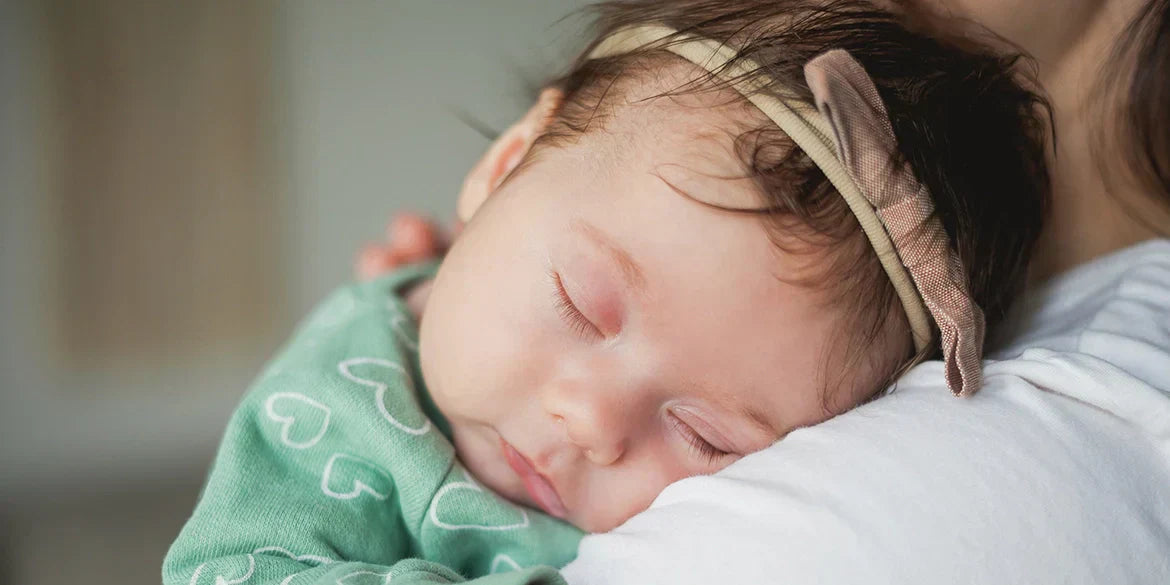
First they don't fall asleep, then they keep waking up. The baby only sleeps in their arms, and in order to achieve any small partial success, mom or dad have to carry them constantly. It just doesn't work with the longed-for baby sleep, the baby can't be put down.
A few weeks are enough to turn fun-loving parents into wrecks. For some, this picture may seem exaggerated, but for others, especially parents of cry babies, it may describe a grim reality.
But the situation is by no means hopeless. In this article you will find some information and tips to help you get through this phase better and more relaxed.

Baby only sleeps in your arms: why your baby can't be put down
First of all, it's important to realize why your baby can't help it. The reason can be found in prehistoric times. Back then, dangers lurked everywhere and sleeping too deeply and soundly could have meant death for babies. That's why nature had equipped them with a safety mechanism.
The little ones woke up again and again to make sure that they were still safe and sound. If there were any signs of danger, they would raise the alarm by crying out loud. This mechanism has remained with us to this day.
When the child wakes up, the first thing it does is check whether all the conditions in the environment are still the same as when it fell asleep. If this is not the case, because the pacifier or the pleasant rocking while falling asleep is missing, this is an alarm signal for your baby.
Movement as the key to peaceful baby sleep
If, on the other hand, your little one wakes up in a carrier, baby carriage or in your arms, they will feel safe because they can feel the movement. This calming effect can be traced back to the time in mom's womb, the epitome of safety and security.
There, the baby was exposed to constant movement. So if it wakes up from the deep sleep phase and senses movement, there is a good chance that it will continue to slumber peacefully. Movement during the individual sleep phases can therefore be a great help.
However, this has a disadvantage: as soon as the movement stops, for example because you put the child down, you are back to where you started. The swing2sleep can help with this. In the following interesting video, you can find out why putting your baby down can be so difficult or why they keep waking up after being put down.
Fall asleep alone in bed? Never!
Some parenting guides recommend that babies should be accustomed to their own bed as early as possible. In some cases this may be successful, but it is not uncommon for the attempt to be a frustrating experience for parents and child alike. Here too, a look back to the Stone Age can help. Babies are baby carriers.
This means that they are designed by nature to be carried in their parents' arms. The need for physical closeness is correspondingly great. It is therefore not surprising that your baby would much rather fall asleep in your arms than alone in bed, as this gives them a sense of security. Especially in the first few months, many parents swear by co-sleeping in the parents' bed.
Valuable tips: Breathe!
Mother's breathing reminds the baby to breathe by the sound of breathing in and out, the rising and falling of the chest and the exhaled carbon dioxide. This is a safety system that kicks in if the baby's breathing stops.
Sleeping alone represents a neurobiological crisis for the child, because in such a situation it is left to its own devices and its basic needs, but is not equipped for this. In addition, it helps the baby to regulate vital bodily functions such as breathing, temperature, oxygen saturation and blood pressure through physical contact.
Alone in the crib: What your baby needs
It is questionable when the right time has come to banish the baby from the parents' bed or even the bedroom. In the so-called Western world, which we quietly equate with "civilized", we would prefer to have our bed to ourselves again after six months. In most other parts of the world, very small babies are always close to an adult, are carried in slings so that the parents have their hands free and many babies cannot be put down during the day.
In the non-Western world, it is considered completely normal for small children to be cuddled up to their mothers almost all the time. After all, this is the body in which they have spent nine months. As a result, the family bed is considered normal in most other cultures.
The fourth trimester - postnatal pregnancy?
Quite a few babies struggle with adjustment difficulties after birth. It was not only warm and cozy in the mother's womb, it was also never bright and certainly not loud.
The baby was in constant contact with its mother, never alone. The changes that birth brings with it are so serious that the baby longs to be back in mummy's womb for the first time.
Does this mean that the child was not really ready to be born? This is actually true in some respects.
In his book "The Happiest Baby in the World", US pediatrician Dr. Harvey Karp talks about a fourth trimester of pregnancy. According to his theory, the child therefore needs at least another three months, others assume around nine months and still others twelve months until the child is out of the woods.
The reason for the (too) early birth of human babies is simply that the head would otherwise be too big for the vagina. In view of the fact that the first period after birth is more or less a continuation of the pregnancy outside the body, the idea of letting the baby sleep alone seems rather absurd.
What to do if the baby can't be put down?
At first, the realization that the pregnancy is not yet over may seem shocking or even frustrating. However, this is actually the key to solving the problem.
Again, this solution will take a lot out of you, but compared to the ordeal of a constantly crying and unhappy baby and regular sleep deprivation, it could almost be like a vacation. By knowing the causes of the sleep problems, you can respond directly to the child's needs.
As the baby should actually still be in the womb in terms of its development, you can try to simulate the conditions that prevailed there as closely as possible in the first few weeks of life.
Every child works differently
Give the baby as much security as possible. This includes, for example, meeting the baby's immediate needs. In the womb, the baby was nourished by the umbilical cord without first having to draw attention to itself in hunger .
In the "fourth trimester", it is important to feed the child as soon as it is hungry and to give it immediate closeness. In the first year, this is a necessity and has nothing to do with spoiling You can also imitate the tightness or sounds of the womb, for example by swaddling the baby or placing it in a cradle from swing2sleep .
At the same time, you can soothe it with sounds such as humming or humming.
Carrying the baby around (ideally with a sling or a carrier ) also has a calming effect on the little one.

White noise when lying down
White noise sounds very similar to the sounds your baby heard in the womb, and there were quite a few: the flowing of blood, the hissing of air when breathing in and out or the vibrating of vocal cords.
The constant noise can also help your child to sleep through the night because it blocks out irregular background noises, such as cars, slamming doors, etc., which are mostly unknown to the child. Dr. Ralph Pascualy, Medical Director of the Northwest Hospital Sleep Center in Seattle, explains that our brain is constantly searching for sensory input.
During sleep, any sound,no matter how small , such as a passing truck or a creaking floorboard,can activate the brain and interrupt sleep. A constant white noise gives the subconscious something to focus on, so it is not so easily disturbed by irregular noises.
Here is our favorite trick with our 3 children
In addition to the swing2sleep, which we originally developed for our own cry baby, we also had a "secret weapon" that worked wonderfully with all our children: If your baby is already about three months old and still prefers to fall asleep in your arms, it helps enormously to have a little friend who is there when the child is supposed to fall asleep.
However, we are talking about a little friend who smells like mom. Take a teddy bear or your baby's cuddly blanket to bed with you for a few nights. This allows the teddy to take on your natural body odor. Your baby will then have the feeling of being close to you when it senses your scent through the friend.
Between light sleep and deep sleep
In the early days, your baby is in an absolute crisis situation because it has been expelled from the nurturing womb before it was actually ready for it. That's why you should try to meet the needs of your little new arrival: Security, carrying and rocking, soft noises and subdued light, warmth and familiar smells. Don't let him lack for anything, especially closeness and love.
If the baby wants to be carried, then carry it for as long as you can; if it wants to be rocked, then rock it until your arms fall off, or simply let a motorized swing2sleep cradle do it for you.
The main thing is that you are happy!
One last "hot" tip: The transition from the swing2sleep to the crib is easier if you pre-warm the bed with a hot water bottle. Who wants to get into a cold bed? I still don't like it to this day ;-).
FAQ: Baby only sleeps in my arms
What can I do if my baby only sleeps in my arms?
First of all: This is completely normal, especially in the first few months of life. Closeness, movement and body warmth give your baby a sense of security. It can be helpful to gradually transfer these conditions, for example through gentle rocking, consistent noises or a calm sleeping environment. It is important to introduce changes slowly and not to work against your baby's rhythm.
How to sleep if the baby won't lie down?
If putting your baby down doesn't work at the moment, carrying aids, baby carriages or gentle rocking movements are often a good support. Many babies continue to sleep better if a gentle movement is maintained. A set sleep routine can also help, as repetition provides security.
Is it okay for a baby to sleep in my arms?
Yes, sleeping in your arms is not harmful for babies and does not spoil them. On the contrary: closeness strengthens the bond and helps the nervous system to regulate itself. As they mature, most babies develop the ability to fall asleep on their own, even without physical contact.
How do I wean my baby off falling asleep in my arms?
Not by abruptly weaning your baby off, but through gentle transitions. For example, put your baby down when he or she is already sleepy but not yet fast asleep. Stay with them, speak softly or place a hand on their tummy. In this way, your baby will learn step by step that it can fall asleep safely without an arm.