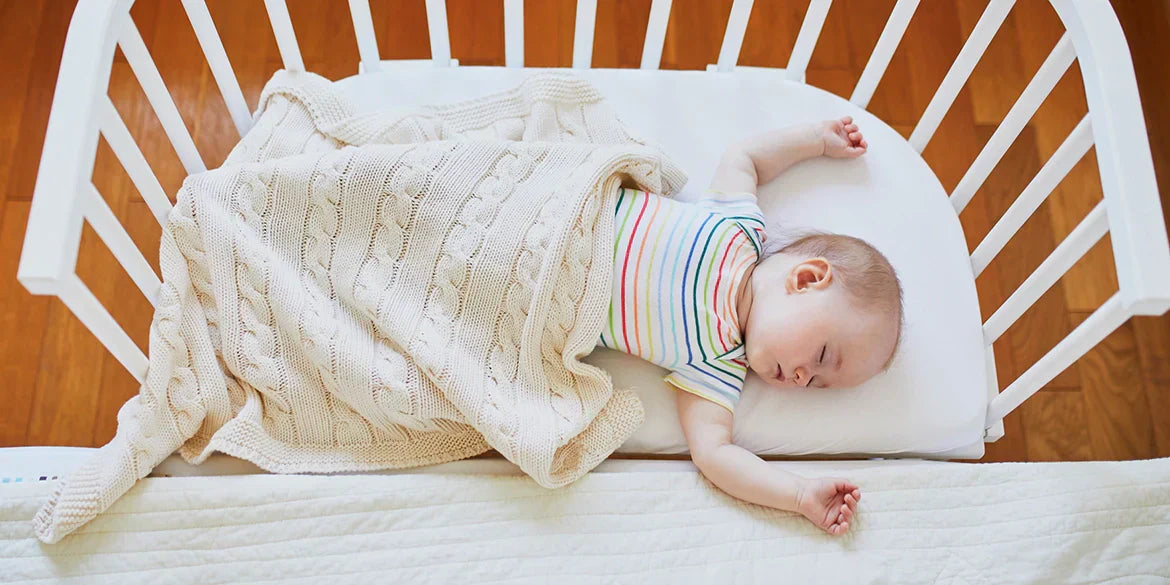


How do newborns sleep in the first few weeks of life?
In the first few weeks of life, newborns spend most of the day sleeping - 16 to 18 hours a day is not uncommon. The sleep phases are spread over many short intervals: your baby usually only sleeps for two to four hours at a time - whether during the day or at night. There is no regular day-night rhythm at this early stage.
This is mainly due to the fact that the sleep-wake rhythm of a newborn baby is not yet fully developed. In the womb, there was no difference between day and night - this distinction has to develop over time. Melatonin production, which later plays an important role in falling asleep and staying asleep, also only starts after a few weeks.
In addition, babies sleep in a significantly different sleep cycle to adults in the first month: the phases are shorter, the brain is more active and the change between light and deep sleep occurs more quickly. This has an evolutionary background: frequent waking serves as protection in order to express needs such as hunger or closeness at an early stage.
It is important to note that these seemingly irregular sleep patterns are completely normal. Even if your baby's sleep doesn't seem very predictable in the first few weeks, they form the basis for more stable sleeping habits later on.
Why do newborns wake up so often?
There are good reasons why your baby wakes up so often in the first few weeks of life - even if it is often challenging for new parents. The sleep phases of a newborn are short and interrupted by many waking phases, which is completely natural.
A common reason for waking is simply hunger. The little stomach needs to be filled regularly - breastfed babies in particular demand their milk every two to three hours in the first few weeks. But wet diapers, the need for closeness or a slight external stimulus can also wake your baby.
In addition, many babies are still in a temporary phase of adjustment after birth: noises, light and temperature differences are new - sleep is correspondingly lighter and more restless. During this phase, it helps to give the baby as much physical contact as possible and to create a safe, secure sleeping environment.
As exhausting as it may be, these frequent nights with interruptions are not permanent. Over time, your baby will learn to sleep longer - and gradually get used to a more regular rhythm.
Newborns wake up frequently because their sleep is still light and interrupted by needs such as hunger, closeness or stimuli - but over time a more stable rhythm will settle in.
How can parents gently support baby's sleep in the first month?
In the first few weeks of life, it is particularly important to give the baby lots of closeness and security in order to promote baby sleep . Newborns often only sleep for short periods at a time and need a lot of physical contact to feel safe and comfortable. Breastfeeding or carrying supports bonding and has a calming effect.
A structured daily routine with gentle routines - such as regular nappy changing, soothing humming or dimmed lights - can help to support the still irregular sleep-wake rhythm. These familiar routines give the baby orientation and make it easier to fall asleep.
In addition, for example, swing2sleep spring cradles with a motor can provide additional relaxation with their gentle, rhythmic movements. They offer practical help for parents if their baby has difficulty falling asleep or needs reassurance in between.
With patience, loving support and targeted aids, parents can positively support their baby's sleep, even if longer and continuous sleep phases still need time to develop.

What is an ideal sleeping environment for newborns?
A suitable environment can also help your baby to rest in the first month - even if sleep is still in short phases. It is particularly important to reduce stimuli and create an atmosphere that conveys a sense of security and familiarity.
The sleeping area should be quiet, darkened and at a good temperature - neither too warm nor too cool. Having your own bed close to you is ideal, as it provides structure and security at the same time. A pleasant soundscape, such as a soft background noise, can also have a supportive effect.
The sleeping environment also includes Clothes: Make sure that your baby is not dressed too thickly or too thinly - overheating or freezing can disrupt sleep. If you take these basic conditions into account, you will help your baby to feel comfortable and safe when sleeping - an important basis for more sleep and less restlessness.
Sources:
(1) St. Georg Apotheke Heide - How babies fall asleep and sleep through the night better https://www.st-georg-apotheke-heide.de/gesundheitsbibliothek/index/wie-babys-besser-ein-und-durchschlafen/
(2) Better Health Victoria - Typical sleep behavior: newborns (0-3 months) https://www.betterhealth.vic.gov.au/health/healthyliving/typical-sleep-behaviour-nb-0-3-months
(3) Children's Hospital of Philadelphia - Newborn Sleep Patterns https://www.chop.edu/pages/newborn-sleep-patterns
(4) ELTERN.de - Baby 1st month: Development, sleep, breastfeeding & more https://www.eltern.de/baby/babyentwicklung/baby-1-monat--entwicklung--schlaf--stillen---mehr-13224650.html
(5) KidsHealth - Sleep and Your 1- to 3-Month-Old https://kidshealth.org/en/parents/sleep13m.html