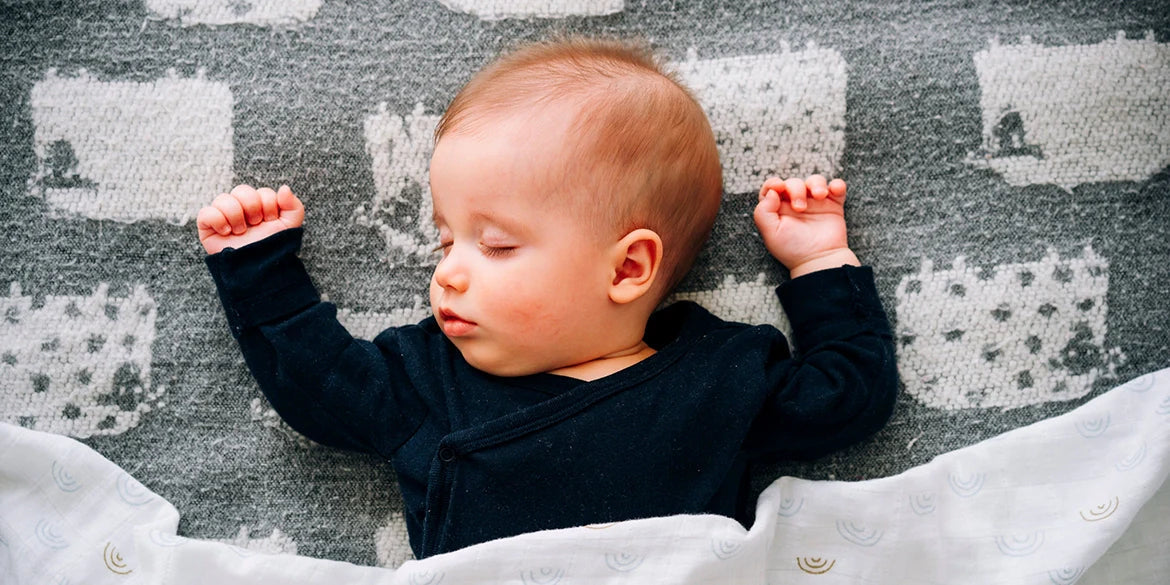


Babies have their own personality right from the start. Some are sunshines, others are downright sourpusses. And some are early risers, others are sleepyheads. Even in the first few days after birth, it becomes clear that every child has its own rhythm.
While some newborns seem to react calmly to their environment and are easily soothed, others need a lot of closeness, movement and time to calm down. These differences are not a coincidence or a "parenting mistake", but an expression of an individual temperament that becomes apparent at an early age.
In fact, many parents are surprised at how different a baby's sleep needs can be. In conversations with other mothers and fathers, comparisons quickly come up: "Mine already sleeps through the night" or "She hardly needs a nap during the day".
However, every baby has their own sleep requirements and these can change several times in the first few months of life. Growth spurts, developmental leaps or new sensory impressions have a direct impact on sleep behavior. What works well today may look completely different tomorrow.
But why is this the case? And what actually happens during sleep? We venture a look into the mystery of dreamland, where little bodies grow, impressions are processed and the foundations for learning, health and emotional stability develop.

How different are babies' sleep needs really?
Sleep needs are largely genetically determined and are as individual as their personality. There is no such thing as a normal amount of sleep. Adults sleep an average of 7-8 hours per night. The recommended optimal amount of sleep is 7.5 hours.
This promises the best health and longest life. However, there are also people who find it easy to get up and go to work after just 5 hours of sleep. Others, on the other hand, need 9-10 hours' rest in order to be fresh and productive during the day.
If we exceed or fall short of our personal sleep optimum for a longer period of time, we soon feel the consequences. Just one hour's sleep less than usual, and after just a few nights we are walking around during the day like counterfeit money.
We are tired, exhausted and can hardly concentrate. If, on the other hand, we overdo it and sleep an hour longer than we need every night over a longer period of time, we find it harder to sleep at night and wake up more often. For refreshing sleep, it is not only the total duration of sleep that is important, but also the quality of sleep.
We spend around a third of our lives sleeping. Sufficient sleep is essential for our development and health. While we sleep, important recovery processes take place in the body. Metabolism is regulated, the immune system is immensely strengthened and growth hormones are released.
This also applies to babies. Good, healthy sleep is like a rollercoaster ride in some respects: the maximum relaxation phase is followed by maximum activity in the dream phase. Sufficient rest and fresh air are of course important here. Sleeping makes you happy, healthy and smart.
Daily experiences are processed
During sleep, it seems as if the body and brain are in sleep mode. However, this is a fallacy, especially when it comes to our thinking organ, because a lot of processes take place there when we sleep.
The experiences of the day are sorted and evaluated in order to be able to absorb new things the next day. In order to carry out this processing, the brain needs absolute rest. During the day, too many distracting sensory impressions interfere with this process.
Even learning takes place to a large extent during sleep. What is loaded into the buffer of the waking consciousness during the day sinks into long-term memory at night. New information, experiences and adventures are consolidated in the memory in the long term.
Emotions, both negative and positive, are also stored in different regions, and even newly learned motor skills are memorized during sleep. We are particularly good at retaining learning content that we absorb shortly before falling asleep.

Do babies need different amounts of sleep?
In the first three months, babies sleep an average of 16 to 18 hours a day. This is evenly distributed over approximately six sleep phases. However, the same applies to sleep: Every child is different and deviations from the average are completely normal.
Some children are real marmots, others are very difficult to get to sleep. As with adults, there are also "long sleepers" and "short sleepers" in infants.
Some sleep through the night very early, while other babies take a little longer. And still others sleep through the night for a while until they suddenly stop doing so. Children are full of surprises.
REM and non-REM phases
Just as in adults, sleep in children is roughly divided into two different phases: the REM phase and the non-REM phase.
REM stands for Rapid Eye Movement. This means that the eyes move rapidly back and forth behind the closed eyelids during this phase. In this phase we dream intensively, and it is primarily here that we process and come to terms with what we have experienced.
This sleep phase is also called active sleep because many values such as brain waves, blood pressure, breathing and heart rate are similar to the waking state. However, this does not apply to the muscles. This is a good thing, because otherwise we would actually perform the movements we experience in our dreams and possibly injure ourselves or others.

The non-REM phase
The non-REM phase is everything that is not the REM phase. In fact, this division is a bit simple. The non-REM phase includes the falling asleep phase, the light sleep phase and the deep sleep phase.
All these phases are passed through one after the other and culminate in the REM phase. We then wake up briefly and the cycle begins again, a total of four to five times per night.
During the first cycle, the REM phase is still relatively short at around 10 minutes. However, it gets longer and longer with each cycle. At the end of the night, both phases, REM and non-REM, are approximately the same length.
This sleep pattern applies not only to adults, but also to children, albeit in a slightly different form. In children, the proportion of REM sleep phases is significantly higher than in adults. In unborn babies still it is even almost 100 percent!
It is assumed that it is precisely this active sleep that is important for babies and children, as they undergo mental development during it.
In newborns, the proportion of active sleep phases is still around 50 %. In adults, this figure later drops to around 20 %.
Only when the child gets older and is increasingly exposed to the stimuli of its environment does the duration of the individual REM phases decrease. In addition, the baby's sleep cycles are shorter overall.
The fact that babies experience more REM than non-REM phases can also be explained by the fact that light sleep used to give babies a better chance of survival. In this way, it could wake up more quickly in the event of danger, but also when it was hungry.
In addition, newborns sleep for a maximum of 4 hours at a time, but as new parents you have probably already worked that out for yourselves. But don't panic: This will pass.
Babies still have to develop a fixed sleep rhythm
At around 4-6 weeks, sleep patterns gradually become more regular and the baby gradually begins to develop a day-night rhythm. Children of this age usually fall asleep at about the same time in the evening and wake up at about the same time in the morning and at night.
Even very young babies have a certain, albeit limited, ability to calm themselves and fall asleep on their own. For example, by sucking on their little hands, cuddling up to a pillow or blanket or rolling over.
This ability continues to develop in the first few months of life. However, it also varies from child to child and depends on the individual stage of development, the child's personality and the parents' behavior.
However, some children are not yet able to do this. They want to be soothed, rocked and cuddled, even at times when mom and dad actually need their well-deserved sleep.
In precisely these situations, they try all kinds of remedies such as breastfeeding, bottle feeding, running up and down or bouncing on the Pezzi ball for hours on end.
But what do you do when your nerves are on edge, the arm you're using to carry the baby has passed its breaking point and you just want to lie down and sleep...?
The swing2sleep spring cradle can gently help your baby to fall asleep regularly. It rocks and moves your baby steadily and soothingly, so that he or she is blissfully asleep after just a short time. Baby's need for sleep can finally be satisfied, and mom and dad can also get some rest.
Rent the swing2sleep for a month without obligation and see for yourself!
Conclusion: Understand your baby's sleep needs and accompany them calmly
Babies don't sleep according to a stopwatch, they sleep according to their development, temperament and inner blueprint. A baby's sleep needs are as individual as their personality. Some children are relaxed heavy sleepers, others are more alert, sensitive or quicker to be overwhelmed by stimuli. Both are normal.
Sleep is not a passive state, but high-performance work for the body and brain. Growth hormones are released, experiences are processed and new connections are formed in the brain.
The high proportion of REM sleep in infancy in particular shows how intensively babies learn and develop during sleep. Frequent waking or short sleep cycles are therefore not a sign of maldevelopment, but make biological sense.
A baby's need for sleep is not a fixed number, but changes with each stage of development. Growth spurts, new abilities and stimuli from the environment have a direct effect on the duration and quality of sleep.
At the same time, parents can be exhausted. Different sleep requirements often mean different levels of stress in everyday life. It is important to recognize the child's individual needs, avoid comparisons and develop realistic expectations. A stable rhythm develops over time, not through pressure, but through maturity.
With patience, understanding of the child's sleep development and supportive routines, many families gradually find calmer nights. Babies are constantly changing and their sleep develops with them.
FAQ
What is the 2/3/4 rule?
The 2/3/4 rule is a guideline for babies from around 6 months with three daily naps. It describes the recommended waking times between sleep phases: around 2 hours in the morning, 3 hours at midday and around 4 hours before night-time sleep. It is not a rigid law, but a guideline. Every baby reacts differently, so fatigue signals should always be taken into account.
How much sleep do babies need at what age?
Newborns sleep an average of 16-18 hours a day, spread over several phases. At 3-6 months it is usually 14-16 hours, from 6-12 months about 12-15 hours including daytime sleep. These figures are average values. Individual sleep requirements can be significantly higher or lower than this and still be completely normal.
What is the 13-minute method?
The 13-minute method is a sleep coaching approach. It involves waiting about 13 minutes before intervening when waking up or falling asleep at night. The aim is to give the baby space to find its own way back to sleep. It is important to remain sensitive and not to place rigid times above the child's actual needs.
When is the best time for babies to go to bed?
For many babies, the right bedtime is between 6:30 and 8:00 pm. However, it is not the time alone that is decisive, but the correct waking time before this and visible signs of tiredness. An overtired baby often falls asleep less easily and wakes up more often. A consistent evening routine supports a stable rhythm.