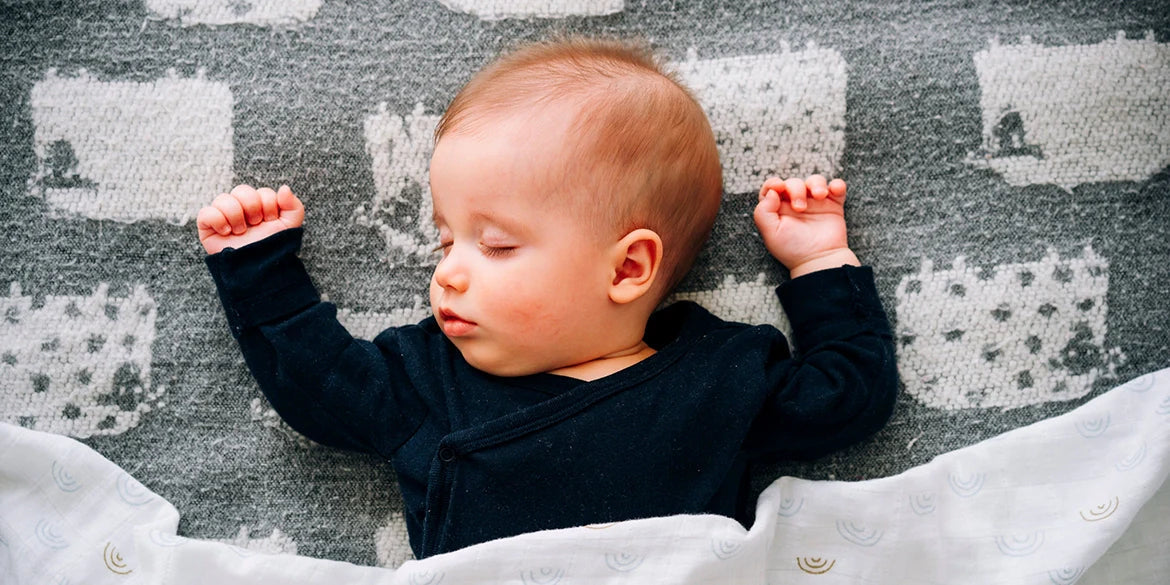



Sooner or later, many parents ask themselves exactly this question: How much sleep does my baby need to grow healthily, be happy and develop well? Especially in the first few months, sleep seems to be the central issue in everyday family life and at the same time the biggest puzzle.
Perhaps you have the feeling that your baby is sleeping too little. Perhaps it sleeps significantly more than a friend's child. Perhaps it wakes up frequently at night, although other babies are supposedly already "sleeping through the night". Insecurity quickly arises. Is this normal? Is something missing? Am I doing something wrong?
Here comes the good news: babies' night-time rest does not follow a rigid table. Average values can provide orientation, but they are not a benchmark for each individual child.
Rest is a biological maturation process and is individual. Some babies manage with fewer rest periods, others need significantly more. Both can be completely healthy.
In this article, we look at how sleep needs develop over the first three years of life, why baby sleep works very differently to adult sleep and how you can tell whether your child is actually getting enough rest. The aim is not to set an ideal, but to create security.
Because in the end, it's not just about how long a baby sleeps. It's about whether it can develop well, whether it seems balanced and whether you as parents regain a bit of serenity.

How much sleep does my baby need by age?
Numbers can provide guidance as long as they are not confused with rigid rules. When parents ask themselves: How much sleep does my baby need? But the range is important, not the exact average.
Here is a compact overview:
| Age of the child | Average sleep per day | Typical distribution |
|---|---|---|
| 0-3 months | 16-18 hours | Many short phases throughout the day & night |
| 3-6 months | 14-16 hours | First longer night phases possible |
| 6-12 months | 13-15 hours | More night sleep, 1-2 daytime naps |
| 1-2 years | 12-14 hours | Stable night-time sleep + afternoon nap |
| 2-3 years | 11-13 hours | Mostly 1 afternoon nap |
Important: These are average values from large observation groups. Individual children can be significantly above or below this and still be completely healthy.
The decisive factor is not the number on the clock, but your child's behavior:
Does it seem balanced? Is it attentive? Is it developing in line with its age? If so, they are most likely getting enough sleep, even if it doesn't fit exactly into the table.
In the next section, we explain why baby sleep works biologically differently to adult sleep and why waking up frequently is completely normal.
How much sleep does my baby really need?
The real uncertainty often starts here. Parents read figures, compare hours and then realize that their baby doesn't stick to the theory.
The more honest answer is: as much as his immature nervous system can process. And this nervous system works completely differently to that of an adult. It is still in the midst of maturing.
Sleep phases are shorter, transitions more unstable and waking moments more frequent. However, this does not automatically mean that something is wrong. Rather, it shows that development is taking place and that sleep is only gradually stabilizing.
Sleep cycles and frequent waking
Babies sleep differently to adults. While an adult goes through around 90 minutes per sleep cycle, a baby's cycle only lasts around 40 to 50 minutes. At the end of each cycle, there is a short activation phase. In a sense, the baby checks its surroundings before slipping back into the next sleep phase.
There is also a high proportion of REM sleep. This phase is particularly important for brain development. Babies spend almost half of their sleep in this state, adults only around a quarter. However, more REM sleep also means lighter, more interruptible sleep. Frequent waking is therefore biologically sensible.
It fulfills several functions:
- Securing closeness and bonding
- Regular food intake with a small stomach
- Adaptation to environmental stimuli
- Supporting neurological development
Therefore, the question "How much sleep does my baby need?" should not only be based on the number of hours. The entire sleep structure is crucial. Several shorter sleep phases are completely physiological in the first few months of life.
The term "sleeping through the night" is also often misunderstood: Medically, it only means five to six hours at a stretch, not a completely restful night.
Day-night rhythm and developmental spurts
Newborns are born without a stable internal clock. The 24-hour rhythm only develops gradually when the body begins to reliably release melatonin.
Light, darkness and recurring routines support this process, but it cannot be accelerated. This is why babies can barely distinguish between day and night in the first few weeks.
During this phase in particular, many parents report: "The baby does not fall asleep " or finds it difficult to rest in the evening. This is often not due to bad habits, but to the fact that the biological rhythm is not yet stable.
Even later on, night-time rest remains closely linked to development. Phases in which a previously stable rhythm suddenly becomes more restless are usually associated with maturation processes.
New motor skills, linguistic progress or teething temporarily change the sleep pattern. At such times, it quickly seems as if the child does not want to fall asleep, but in fact it is processing intensive developmental steps.
In addition, development is often accompanied by increased internal activation. The nervous system is under greater strain and impressions are processed more intensively. Some children then seem particularly awake or restless in the evening.
If the child does not fall asleep, this does not automatically mean that they do not need sleep, but sometimes that they are learning a lot.
Recovery is therefore not linear, but happens in waves. If you take this into account, you will see restless nights less as a problem and more as part of a natural growth process.

How much sleep does my baby need for healthy sleep?
Healthy baby sleep cannot be determined solely by the number of hours. Much more important is the question of whether your child appears rested overall and is developing well.
There is no fixed number that applies to everyone. Sleep is individual. Some babies need more rest, others can manage with a little less. The decisive factor is how the child appears in everyday life. Does it seem attentive? Can it engage in brief interactions? Is it predominantly content or quickly overstimulated?
The interplay between waking and sleeping phases also plays a role. Waking times that are too long can lead to overtiredness, while those that are too short can sometimes prevent sufficient sleep pressure. A balanced ratio is usually not achieved through rigid schedules, but through observation.
So instead of looking exclusively at tables, it is worth looking at your own child. His or her signals usually provide the most reliable indications as to whether rest is sufficient and when it is the right time to fall asleep. This is exactly where the signs of tiredness come in.
Recognizing tiredness and avoiding overtiredness
Whether a child is getting enough rest is shown less by the time of day than by their behavior. Babies often send signs of tiredness early and subtly. If you recognize these signals, you can better determine when to put your child to sleep before fatigue sets in.
Typical early signs of tiredness are
- Looking away
- becoming quieter
- less interest in playing
- slight whining
- yawning
- rubbing eyes
If this moment is missed, the body can go into a state of stress. This sounds paradoxical, but it is biologically logical: overtiredness leads to an increased release of stress hormones such as cortisol. These make it more difficult to fall asleep, even though the child actually urgently needs sleep .
This is exactly when many parents experience the situation: the child doesn't fall asleep, seems over-excited or cries. Not because it doesn't need any rest, but because the ideal time has been exceeded.
What helps here is observation rather than a rigid schedule. Some babies need shorter periods of wakefulness, others can cope for longer. Rigid times can provide orientation, but are no substitute for close observation.
A baby who gets enough sleep appears more balanced overall, shows interest in their surroundings and can regulate themselves well with support. It is therefore not only the duration of sleep that is decisive, but also how the child presents itself in everyday life.
The next section looks at how you can specifically support the natural sleep rhythm through rituals and a suitable environment.

Rituals, routines and a suitable sleeping environment
Babies benefit from repetition. Their nervous system loves predictability. When routines are regular and calm, the body recognizes that the sleep phase is about to begin.
Rituals do not have to be elaborate or perfectly orchestrated. What matters is consistency.
A simple sequence that is always the same can be enough:
- dimmed light in the evening
- calm voice and slower tempo
- nappy changing, pyjamas, breastfeeding or bottle feeding
- a short song or soft humming
Repetition creates security. And security makes it easier to let go, and the sleeping environment also plays an important role. Babies react sensitively to stimuli. Light that is too bright, loud noises or changing conditions can make it difficult to fall asleep. A calm, consistent environment, on the other hand, supports internal regulation.
What you can look out for:
- a room temperature that is as constant as possible
- Reduced light sources
- constant background noise
- little visual distraction
This does not mean that absolute silence is necessary. In fact, many babies sleep better with consistent background noise. The important thing is that the conditions do not constantly change.
Gentle support and when medical advice is advisable
Babies are not yet able to regulate themselves in the first few months of life. They need support to switch from activity to relaxation. Closeness, rhythm and movement often have a calming effect because they remind them of their time in the womb.
Consistent, monotonous stimuli help the nervous system to switch from waking mode to sleep mode.
Gentle support can look like this, for example:
- calm rocking or carrying
- steady movements
- quiet humming or talking
- physical contact and warmth
- Familiar support for falling asleep
Some children enter the sleep phase more quickly when they feel gentle movement. This is not "getting used to", but a form of co-regulation, i.e. joint reassurance. As they mature, many babies gradually become more independent in falling asleep.
It is important to observe your own child. If, despite a calm environment, suitable waking times and loving supervision, the child continues to have difficulties, a specialist assessment may be advisable.
Medical advice is particularly appropriate if
- extreme restlessness or persistent crying occur
- breathing problems or unusual noises are noticeable when sleeping
- the child hardly sleeps and seems permanently exhausted
- there are also developmental abnormalities
In most cases, fluctuations in recovery times are a completely normal part of development. The decisive factor is not just the number of hours, but the interplay of behavior, maturation processes and individual disposition.
Recovery times change with growth stages, new skills and inner maturation, and this is precisely where its dynamics lie.
Conclusion: trust instead of comparison
Baby sleep is not a competition and does not follow a rigid plan. Guidelines provide orientation, but the decisive factor is how your child develops and behaves overall. Frequent waking or restless phases are usually part of normal maturation.
Balance, development and security are more important than the exact number of hours. With attention, appropriate routines and a little calmness, the natural sleep rhythm can be accompanied, not forced.
Gentle movement can support this: A cradle can help your child to calm down more quickly and extend short sleep phases by rocking them evenly. In the end, what counts is trust in your baby's development and in your own feelings.