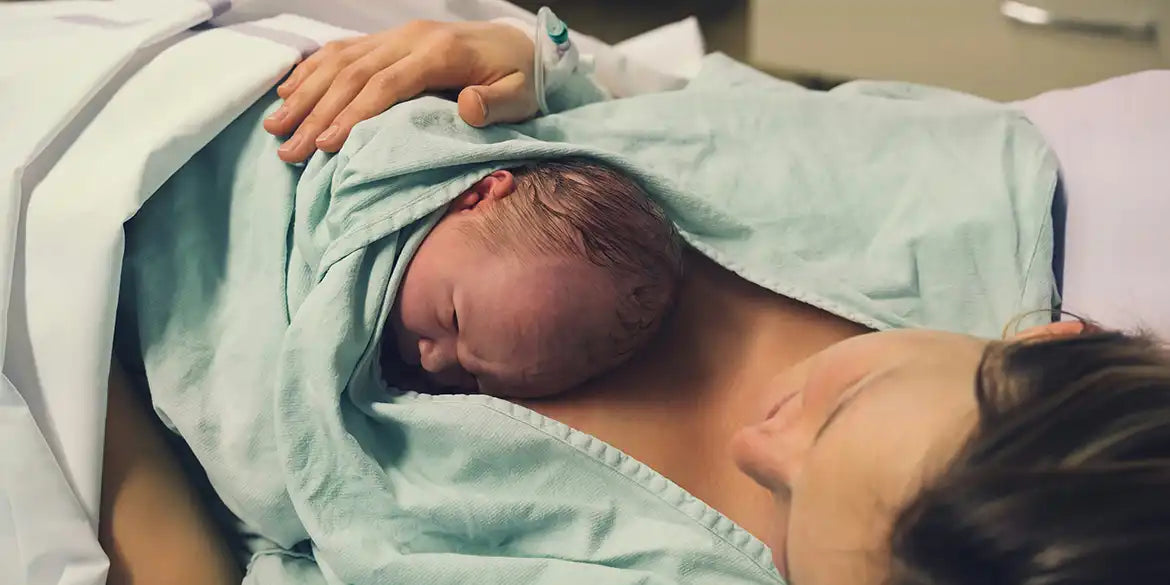



Maybe that's exactly how you feel right now. You're exhausted, just functioning and wondering how much longer you can keep it up. Nights are short, sleep is restless and even when your baby is finally asleep, you often can't switch off straight away. Welcome to a phase that many parents experience, but which is far too rarely talked about honestly.
Because a lack of sleep from your child is not just "being a bit tired". It's a condition that can push you to your limits physically, emotionally and mentally. You are more irritable, less resilient, perhaps even sad or overwhelmed. And at the same time, you're expected to function, take care of yourself and be there.
The truth is: you are not alone in this. Many parents experience this extreme lack of sleep, especially in the first few months of life. And even if it feels endless right now, there are ways to manage this time better.
In this article, I'll show you why your sleep is so challenged right now, what's happening in your body and, above all, how you can find more energy, peace and quiet and little moments for yourself again despite sleep deprivation. Step by step, suitable for everyday life and honest.
Why does your child affect your sleep so much?
If you are currently suffering from extreme sleep deprivation due to your child, it may seem as if something is "wrong". Why do other babies supposedly sleep through the night and yours doesn't? Why are you so exhausted when you're 'only' looking after one child?
The honest answer: Your child is most likely behaving completely normally, but this normality is incredibly challenging.
Babies have a completely different sleep rhythm to adults. Their sleep is lighter, shorter and much more frequently interrupted. In the first few months in particular, sleeping and waking phases alternate at short intervals.
What's more, your baby needs closeness, security and regulation, often at night too. It wakes up because it is hungry, because it is looking for closeness or because it simply wants to reassure itself that you are there.
This means for you: Your sleep is not only interrupted, but also of poorer quality. You are less likely to get the important deep sleep phases that your body really needs to regenerate. This is exactly where this typical lack of sleep occurs in parents, which often feels like a permanent state of exhaustion.
It becomes particularly challenging if your baby finds it difficult to rest, for example if your baby only sleeps on you or constantly wakes up again as soon as you put them down. Phases such as the sleep regression can also suddenly completely disrupt sleep, even if things were going better before.
And then there is another factor that is often underestimated: your own expectations. Perhaps you hoped that sleep would "settle down quickly". Or you've heard that babies sleep through the night after a few months. But in reality, sleep and children are a topic that takes time, development and a lot of individual differences.

Why does lack of sleep affect you so much physically and mentally?
Sleep is not a break, it is vital. While you sleep, your body works at full speed: cells regenerate, your immune system is strengthened and your brain processes what you have experienced.
If you are permanently deprived of this sleep, it has noticeable consequences, often sooner than you might think. This is because your body doesn't get the rest it needs to stabilize itself and build up new energy.
You may be familiar with this:
- You get irritable more quickly, even though you don't want to be
- You find it harder to concentrate
- Small things suddenly overwhelm you
- You feel emotionally thin-skinned or empty
This is not a sign of weakness. This is a completely normal reaction to sleep deprivation.
This is also noticeable physically: Your energy levels drop, your body is under constant stress and even simple tasks feel exhausting. Many parents describe this condition as "functioning in a fog".
And that's exactly why it's so important to look not only at your child, but also at yourself. Your sleep. Your boundaries. Your needs. Because only if you are reasonably stable can you muster the strength to be there for your child.
Why a lack of sleep changes your thoughts and feelings
If you don't get enough sleep over a long period of time, it's not just your body that changes, but also your inner self.
You may notice that your thoughts are spinning. That you doubt more quickly. That you see yourself more critically than usual. Things that you used to take in your stride are suddenly hitting you harder.
Typical thoughts can be:
- "I'm not patient enough."
- "I'm not doing this well."
- "Others can do it too."
And this is where it gets tricky: because these thoughts often feel very real, but are in fact often a result of exhaustion.
Sleep deprivation has a direct effect on your emotions. Your nervous system is under constant tension, your stress levels are elevated and your mind can hardly rest. As a result, negative thoughts become louder, while your inner stability decreases at the same time.
Many parents experience the following during this phase
- greater self-criticism
- the feeling of not being enough
- emotional overload
- or even the first signs of despondency
It is important to note that this does not mean that there is something wrong with you. It just shows how challenging this situation is at the moment.
Prolonged sleep deprivation in particular can also increase the risk of depressive moods, especially if you also feel left alone or have little relief. That's why it's so important to take care of yourself early on.
If you notice that your thoughts are constantly weighing you down and that you often feel sad, empty or overwhelmed, then don't hesitate to get support. A good first point of contact is, for example, TelefonSeelsorge, which is anonymous, free and available around the clock. You don't have to go through this alone.
And above all: your thoughts in this phase are not the truth about you, but a sign that you are carrying a lot right now.

7 strategies against extreme sleep deprivation in everyday life
If you consistently get too little sleep, even the smallest step often feels exhausting. You may feel like you don't have the energy to make changes, which is exactly why many tips seem unrealistic at first.
But this is precisely the point: you don't have to change everything. You don't have to get more sleep straight away or restructure your entire daily routine.
What really helps you are small, feasible adjustments. Things that don't put you under additional stress, but relieve it. Strategies that can be integrated into your daily routine, even when you're tired.
- Sleep when your baby sleeps (even during the day): Yes, the household chores stay put. But your energy is more important right now.
- Mini-breaks instead of perfection: Even closing your eyes for 10-15 minutes can make a difference.
- Consciously reduce tasks: Ask yourself: What is really necessary today and what can wait?
- Actively ask for help: Family, friends or your partner, you don't have to do it alone.
- Create little rituals for yourself: a cup of tea, music, a short walk outside, mini moments help your nervous system.
- Expect less of yourself: You are in an exceptional situation. It should feel that way.
- Use exercise & fresh air: A walk can give you new energy, even if you're tired.
This may feel "too easy" at first. But that's exactly where the key lies. It's not the big changes that will help you now, but small, feasible steps that can be integrated into your everyday life.
It's not important to implement everything. Instead, take out what is good for you right now. Sometimes a short break or a moment is enough for you to feel a little more strength again.
These strategies may seem inconspicuous at first glance, but that is precisely their strength: they are feasible, even in an everyday life with a lack of sleep.
How a spring cradle gives you real relief in everyday life
In addition to mental strategies, the right support can also make a huge difference in everyday life.
Many parents know the situation: your baby finds it difficult to settle down, needs movement or closeness to fall asleep. This is exactly where gently accompanying your child can help, for example by rocking your baby to sleep.
A bassinet can be a particularly great relief in such phases. It combines gentle movement with security, which is exactly what many babies need to calm down better. The even up and down movements make many babies feel safe and relaxed, almost like in the womb.
The special thing about it: while your baby swings calmly, you finally have your hands free. You can sit down, take a deep breath or take care of other things. These little breaks are incredibly valuable, especially when your child is extremely sleep-deprived.
In this experience report, parents describe how their everyday life has changed noticeably, especially when nothing really helped before. In one testimonial, a family describes how their baby was previously almost impossible to put down and they had to carry her around the clock. It was only with the spring cradle that their child was able to calm down and they were able to regain little moments for themselves.
And that's what it's all about: Not having to carry everything alone, but finding solutions that take the pressure off both of you.
Conclusion: Extreme lack of sleep due to child
This time can feel like you're constantly pushing yourself beyond your limits. You're functioning, taking care of yourself and doing your best, while at the same time feeling how exhausted you actually are. That's why it's important to understand: This is not a weakness, but a truly exceptional situation.
Many parents experience exactly this situation. Nights full of interruptions, days in function mode and the feeling of losing yourself somewhere in between it all. But even if it feels endless right now, this phase is changing. Your child will develop, sleep will adapt and little by little it will get easier.
Until then, it's not about functioning perfectly. It's about relieving yourself where you can. Use small breaks. Accepting support. And finding solutions that really make your everyday life easier, be it through routines, outside help or practical support that gives you some breathing space.
You don't have to go through this alone. You can be tired, you can be overwhelmed and you can get help. Because even if extreme sleep deprivation caused by your child is currently dominating your life: You are not going down this path alone. And you will get through it.